
National College Savings Month: 529 Plan vs. Savings Account: Which Is Right for Your Family?
When you want to help pay for your child's future education, where should you actually put the money? September is National College Savings Month, which means it’s a great time to consider that question, especially if you are comparing a 529 plan vs. savings accounts.
Families learning how to save for college may be starting years before graduation or working with a much shorter timeline. The account you choose can affect potential growth and how easily your student can use the money later. Your comfort with investment risk also matters.
Saving for college expenses doesn’t mean you need to map out the entire cost right from the start. You can start with a goal that fits your household budget and adjust it over time. Energy One's financial education resources can also help you build savings habits that support future education costs and your current financial priorities.
529 Plan vs. Savings Accounts: Where the Differences Matter
So how do 529 plans stack up against savings accounts? This side-by-side comparison shows some of the major differences between them:
The biggest differences between these college savings options relate to purpose and access. A 529 college savings plan is an investment account designed specifically for education. A regular savings account grows over time while keeping your funds available for a broader range of needs.
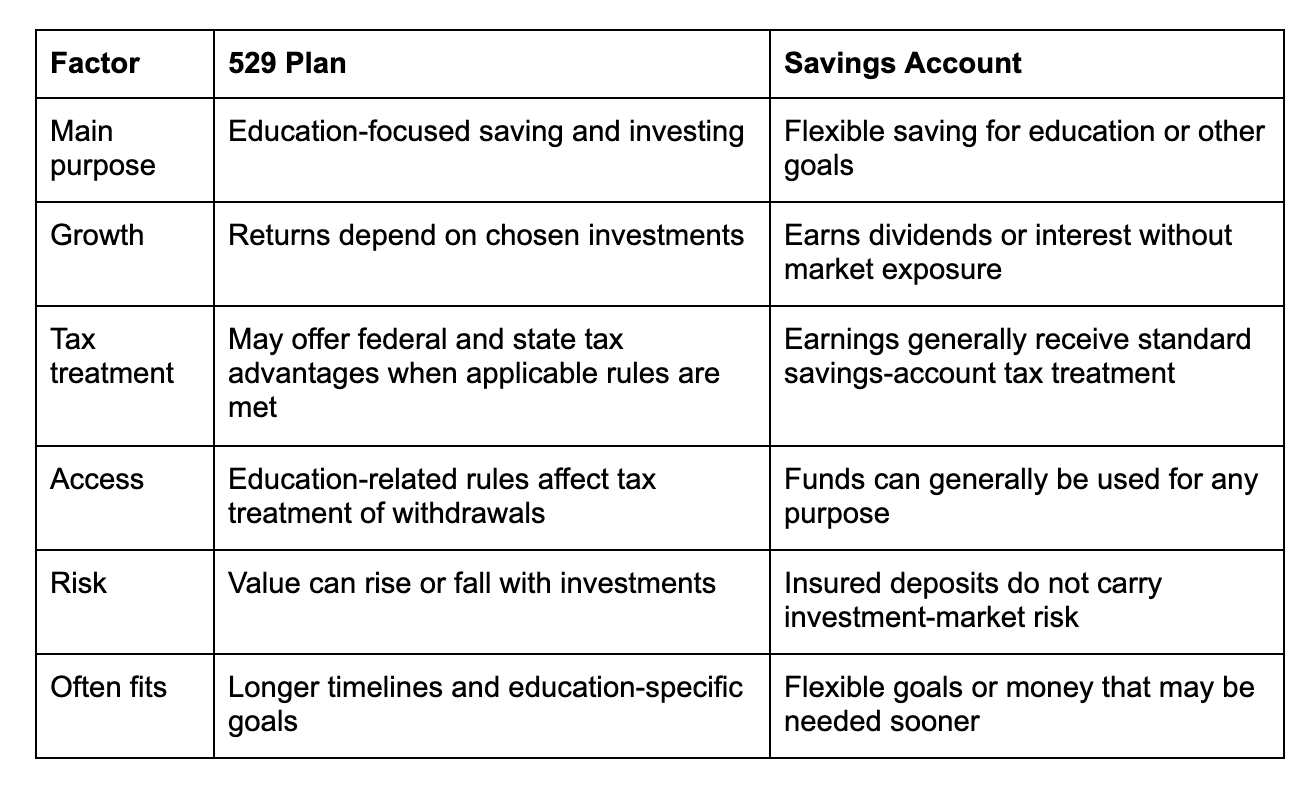
Eligible deposits at a federally insured credit union also receive federal share insurance up to applicable limits.
A 529 account vs. regular savings account comparison often comes down to your timeline and how certain you are about the money's future use. A longer timeline may make investment growth potential more appealing. When the money might be needed sooner, direct access can carry more weight.
Your intended use can help point you toward the education savings plan that fits your family.
What a 529 College Savings Plan Offers
A 529 college savings plan is a tax-advantaged account designed to help families save for education. Most 529 education savings plans let you select from investment choices, which means the balance can rise or fall as those investments change in value.
Among the main 529 plan benefits is the potential for tax-advantaged growth. Under federal tax rules, earnings generally aren’t subject to federal income tax when distributions are used for qualified education expenses. Some states also provide tax benefits specific to 529 plans.
Keep in mind that the 529 plan rules specify that using money for expenses that don’t qualify can make part of a withdrawal taxable. This means you could pay an additional 10% federal tax on earnings.
For families considering education investment options, time matters. If it will be a while before your student is ready for college, invested money has more time to potentially grow, though it’s still possible to face market losses. As your child gets closer to using the money, you may decide to keep investments more conservative to preserve the balance.
529 plans can be useful for long-range college tuition savings when education is the clear goal. To open a 529 plan, you’ll go through an eligible state program or provider.
Why a Savings Account Can Give Families More Flexibility
A regular savings account can give you more freedom over how the money is eventually used. That might matter if your child's education plans change or your family needs part of the balance for expenses that don’t receive favorable 529 tax treatment.
At Energy One, our savings options can help you separate education money from everyday spending while keeping it available for other family needs. This can be a practical form of credit union college savings when flexibility is a priority.
Energy One's Ownership Share Account also gives members a way to start with a modest opening amount and earn dividends as the balance grows. With no fixed maturity, it can provide a straightforward place to build education savings over time.
Savings accounts don’t carry the same kinds of investment-market risk as 529 plans. The tradeoff involves growth potential and tax treatment. A standard savings account does not provide the same education-specific tax advantages as a 529. Its long-term returns may also be lower than successful investments. Families should weigh those differences against the value they place on steady access to their money.
To easily set up a college savings account, you can earmark a regular savings account for education and track it as its own goal within your budget. Families with larger balances can also consider whether an Energy One money market account better fits their access needs.
A Youth Savings Account Can Make College Saving More Tangible
Even though early college savings are usually set up by parents and grandparents, kids can still take part. A youth savings account gives a child a place to see contributions build, connecting everyday money choices with a future purpose.
Our youth accounts include Kid's Cash Club for members aged 14 and younger. The account can be opened with as little as $5, so a child can begin with birthday money or savings of their own.
You might decide that part of each cash gift the child receives will go toward education. You can also do a simple family match, like adding a dollar for every dollar your child saves up to an amount that works for your budget. These routines can help you save for your child's education while giving your child a visible role in the goal.
Energy One also offers ideas for building money habits at home, which can support the saving skills children use as they grow.
For students ages 15 to 24, Student Checking can support day-to-day spending as your teen or young adult begins to manage more of their own money.
Which College Savings Option Fits Your Family?
Parents often ask: What is the best way to save for college? The answer depends on your timeline and how you expect to use the money. Your comfort with investment risk also matters.
A 529 may fit your college financial planning when you have several years before the money will be needed and expect to use it for eligible education costs.
A savings account may fit when easy access matters more. It can also make sense when college is closer or when your child's plans are still uncertain.
Some families use both college savings strategies. A 529 can hold money intended for qualified education expenses, while a savings account can cover costs where you want fewer restrictions.
Energy One also offers checking options that can support routine spending once a student begins to handle more expenses independently. Keeping spending money separate from education savings can make the purpose of each account clearer.
The best way to save for college can change as your child gets older. Revisit your approach occasionally so your mix of growth and access fits the time remaining before the money may be used.
Turn Your College Goal Into a Monthly Savings Plan
If you are wondering how to start saving for a child's college education, begin with an amount your household can contribute consistently.
Decide what portion of future education costs you hope to help cover, then consider how many years remain before the money will likely be needed.
If it works for your budget, set up an automatic transfer to make regular contributions easier to maintain. Our online banking can help members move money between eligible accounts and manage recurring transfers.
It also helps to keep family budgeting for education in context with the rest of your finances. Building financial wellness includes balancing future goals with current bills and emergency savings. Other household priorities may also affect what you can comfortably contribute.
Start With a College Savings Step That Fits Your Family
Choosing between a 529 plan vs. savings account comes down to what you want the money to do. Your approach can change as education plans become clearer. An occasional source of extra income, such as a tax refund, can also help you add to the fund when your regular contribution needs to stay modest.
At Energy One Federal Credit Union, while we don’t offer 529 plans, we do have savings and youth account options that can help families work toward education goals at their own pace. If flexible savings fits your plan, Energy One membership can connect you with the accounts and digital tools you need to work toward financial wellness.
Become a member today.
Get started by opening a free checking account online today.